As part of implementing the directive of the Head of State, Kassym-Jomart Tokayev, on the development of rural areas, the Government is taking measures to expand employment and entrepreneurship opportunities in rural communities, increase household incomes, and modernize essential infrastructure. Particular emphasis is placed on unlocking the economic potential of border settlements.
Auyl Amanaty: Affordable Financing for Rural Entrepreneurship
Kazakhstan is implementing the Auyl Amanaty programme, aimed at increasing the incomes of rural residents and promoting entrepreneurship in villages and small towns. Its key instrument is concessional microcredit, enabling residents to start their own businesses, expand existing operations, establish cooperatives, and create new jobs in their local communities.
Loans are provided at an annual interest rate of 2.5% for up to 5 years for non-agricultural activities and up to 7 years for agricultural and processing projects. The maximum amount for individual initiatives is 2,500 MCI (Monthly Calculation Indices), or KZT 10.8 million, while agricultural cooperatives and processing projects may receive up to 8,000 MCI, or KZT 34.6 million.
Entrepreneurs also have access to concessional leasing of machinery and equipment for up to 7 years at an annual rate of 2.5%. This enables rural enterprises to upgrade their production assets without a substantial one-off financial burden and to increase production and processing volumes.
To attract qualified professionals to rural areas, the With a Diploma to the Village programme continues to be implemented. Under the programme, young professionals are provided with relocation allowances and concessional housing loans at an annual interest rate of 1% for up to 15 years, provided they work in a rural area for at least three years.
Small towns are being developed in parallel. In 2025, KZT 11.9 billion was allocated to implement 40 infrastructure projects in 21 small towns, enabling the modernization of 42 km of roads and 40 km of utility networks.
Funding priorities are determined with due regard to the economic specialization of each territory. This approach makes it possible to support the activities that are most in demand and hold the greatest potential for each specific locality—from livestock and crop production to processing and services. For residents, this means more opportunities to earn an income and find employment locally, stronger local businesses, and improved access to essential goods and services directly in villages and small towns.
More Than 20,000 Microloans Issued and Over 22,000 New Jobs Created
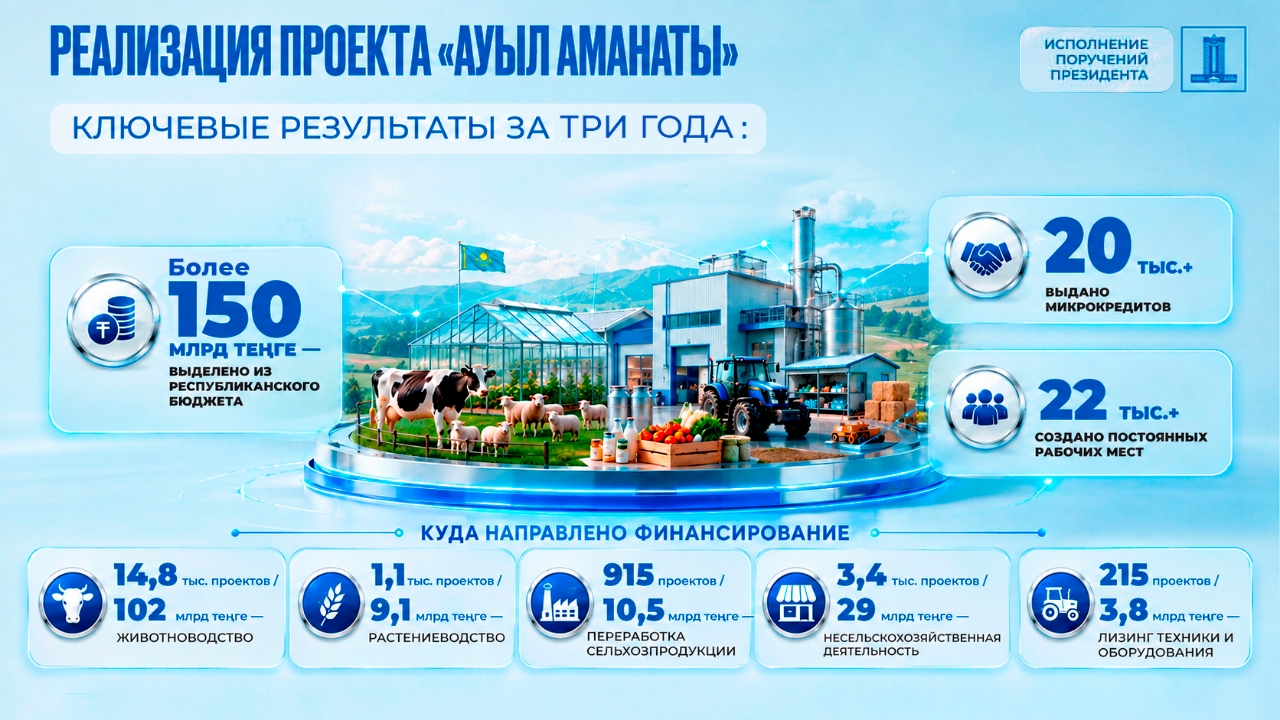
In 2023–2025, more than KZT 150 billion was allocated from the national budget for implementation of the project. During this period, more than 20,000 microloans were issued and over 22,000 new jobs were created.
14,800 livestock projects were supported with KZT 102 billion;
1,100 crop production projects received KZT 9.1 billion;
915 agricultural processing projects received KZT 10.5 billion;
3,400 non-agricultural projects, including services and other types of small business, received KZT 29 billion;
215 machinery and equipment leasing projects received KZT 3.8 billion.
In 2026, 5,400 projects are planned for implementation. To date, 3,132 projects have already been financed for a total of KZT 33.7 billion.
Support covers both traditional agricultural activities and processing, services, and other forms of entrepreneurship, helping to create new sources of income and jobs directly in rural communities.
At the same time, support delivery mechanisms are being improved: new approaches and rules for microcredit and leasing in villages and small towns have been developed.
The updated Microcredit and Leasing Rules provide for preliminary screening of the economic specialization of rural settlements, making it possible to take into account the potential of each territory and direct support to the sectors with the strongest prospects.
Within the financing structure, greater emphasis is placed on developing processing and achieving broader diversification of the rural economy. To ensure a more balanced allocation of funds, a minimum threshold has been established: processing projects must account for at least 20% of the portfolio. At the same time, no more than 50% of the microcredit portfolio may be allocated to the purchase of farm animals.
The established limits are intended to diversify financing, stimulate the development of processing, and strengthen production and distribution value chains.
Economic Diversification: Development of Tourism and Non-Agricultural Businesses
Since 2025, the scope of Auyl Amanaty has been expanded to include new activities not directly related to agricultural production. In regions with tourism potential, residents can obtain concessional financing to open guest houses, develop ethno-tourism and agritourism, and provide food and accommodation services.
This makes it possible to make broader use of each territory's economic potential by creating jobs in the service sector, developing small businesses, and generating additional sources of income for rural families beyond traditional agriculture.
This year, at the instruction of the Head of State, another support mechanism has been introduced under Auyl Amanaty: state loan guarantees through the Damu Fund. This will enable entrepreneurs who lack sufficient collateral of their own to access debt financing and implement projects in rural areas. Practical implementation of the new instrument will begin shortly.
This approach helps create new jobs, broaden income sources for rural families, and establish additional drivers of growth in the regions.
Development of Border Areas: Infrastructure, Employment, and Conditions for Population Retention
The development of border areas is a separate priority of state policy. At the instruction of the Head of State, a dedicated section on this issue has been incorporated into the Rural Development Concept.
The primary focus is on the comprehensive development of border settlements: upgrading social, utility, and transport infrastructure; supporting entrepreneurship; creating jobs; and developing tourism and cross-border trade. These measures are intended to expand local economic opportunities, raise residents' incomes, and create conditions for sustainable development and population retention in border areas.
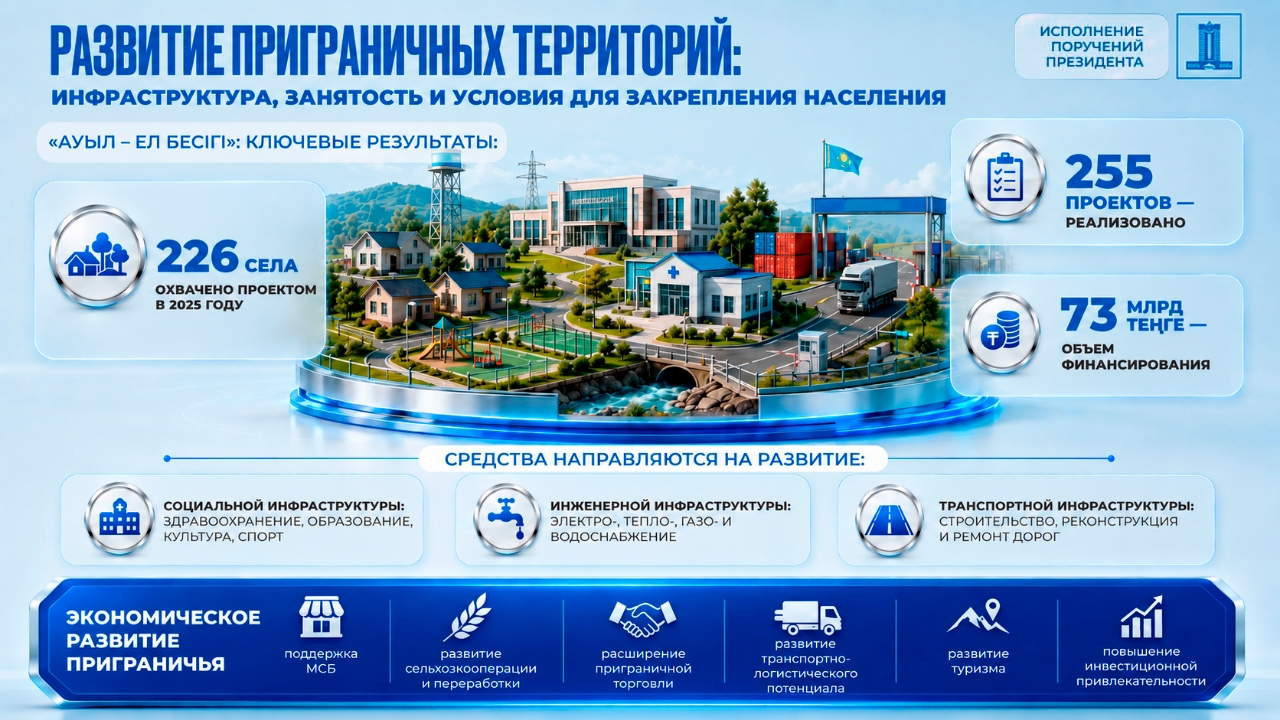
The Auyl – El Besigi project remains the key instrument for upgrading infrastructure in border villages. In 2025, KZT 73 billion was allocated from the national budget and the National Fund for its implementation, enabling 255 projects to be carried out in 226 villages. As a result, 150 social facilities and 67 housing and utility infrastructure facilities were constructed or reconstructed, 180 km of roads and approximately 1,000 km of utility networks were upgraded. In April 2026, amendments were made to the Regional Development Concept to further expand the list of projects eligible for financing under the programme.
State support will be directed toward the construction and modernization of education, healthcare, culture, sports, social, utility, and transport infrastructure facilities, as well as toward creating conditions for entrepreneurship and new jobs in rural areas.
At the same time, the economic dimension of development in border areas is being strengthened by creating conditions for launching new production facilities and services and expanding agricultural processing, trade, logistics, and tourism services.
This approach links infrastructure modernization with job creation and income growth, giving residents more opportunities for employment and entrepreneurship directly in their local communities.