Overview
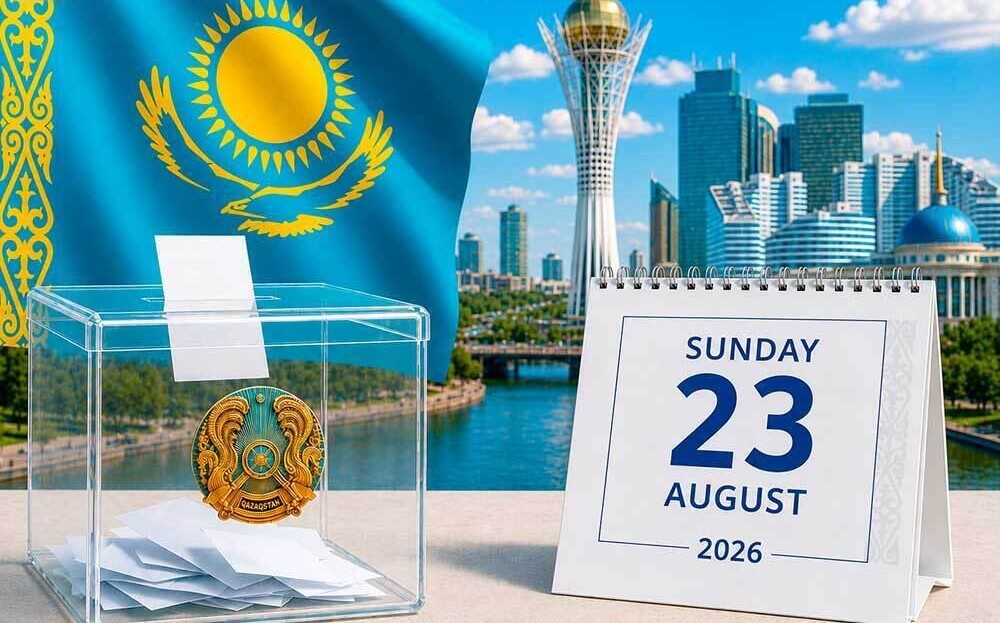
Kazakhstan is holding a national legislative election to constitute the first Kurultai under the Constitution that entered into force on 1 July 2026. Voters will choose among seven registered party lists for all 145 seats in a single nationwide constituency. The vote completes the transition from the former bicameral Parliament - the Mazhilis and Senate - to a unicameral national legislature.
Election at a glance
|
Election day |
Sunday, 23 August 2026 |
|
Institution elected |
Kurultai of the Republic of Kazakhstan |
|
Seats and term |
145 deputies, each serving a five-year term |
|
Electoral district |
One nationwide constituency |
|
Voting system |
Closed-list proportional representation |
|
Electoral threshold |
5% of valid votes cast |
|
Registered electorate |
12,605,788 voters, as of 3 August 2026 |
|
Contest |
Seven party lists and 545 registered candidates |
|
Ballot choice |
One party list or the option ‘Against all’ |
|
Standard polling hours |
7:00 a.m.-8:00 p.m. local time |
Why the election is significant
- Constitutional transition: The new Constitution was approved in the 15 March referendum, with 87.15% of participating voters in favour and turnout of 73.12%. It took effect on 1 July; the former Parliament’s mandate ended and the election was called within the constitutionally required two-month transition period.
- A new legislature: The Kurultai replaces both the Mazhilis and Senate as Kazakhstan’s sole national legislative body. All 145 seats are elected; there are no appointed seats.
- Institutional authority: The Kurultai legislates, approves the national budget, exercises parliamentary oversight and may consider confidence in the Government. It consents to presidential nominees for Vice President, Prime Minister and specified senior posts.
- Immediate next step: The President must convene the first session within 30 days after publication of the results. The Government relinquishes its powers before the newly elected Kurultai.
How the electoral system works
- One national party-list vote: The ballot lists the seven parties in an order determined by lot, then ‘Against all’. Voters do not select individual candidates.
- Closed lists: Seats won by a party are filled according to the order of candidates on its registered list.
- Proportional allocation: Parties receiving at least 5% share the mandates proportionally. If only one party crosses the threshold, the party with the next-highest vote total is also included.
- Party nomination only: Only registered political parties may nominate lists; independent and self-nominated candidacies are not permitted.
Participating political parties
|
Ballot order |
Party |
List size |
Profile and principal priorities |
|
1 |
Adilet Party |
186 |
Jobs and incomes; housing and health care; infrastructure; entrepreneurship; digitalisation and artificial intelligence. AMANAT approved accession to ADILET in June 2026; the combined organisation is contesting under the ADILET name. |
|
2 |
Nationwide Social Democratic Party |
33 |
Social-democratic platform focused on inequality, progressive taxation, labour rights, social protection, anti-corruption, judicial reform and political rights. |
|
3 |
Kazakhstan Green Party ‘Baitaq’ |
47 |
Environmental platform focused on air and water quality, pollution control, renewable energy, ecosystem protection and sustainable urban development. |
|
4 |
People’s Party of Kazakhstan |
72 |
Social-welfare and domestic-development agenda covering jobs, wages, health, education, housing, national industry, regional development and digitalisation. |
|
5 |
Auyl Party |
69 |
Agrarian and rural-development party prioritising agriculture, food security, village infrastructure, rural finance, health care and education. |
|
6 |
Aq zhol Democratic Party of Kazakhstan |
63 |
Pro-market liberal platform centred on entrepreneurship, manufacturing, a smaller state role in the economy, parliamentary oversight and anti-corruption. |
|
7 |
Respublica Party |
75 |
Reform and entrepreneurship platform focused on incomes, manufacturing, effective government, digitalisation, education, inclusion and public safety. |
2023 benchmark: In the March 2023 Mazhilis election, vote shares were: AMANAT 53.90%; Auyl 10.90%; Respublica 8.59%; Aq zhol 8.41%; People’s Party 6.80%; Nationwide Social Democratic Party 5.20%; and Baitaq 2.30%. Adilet did not contest that election, and AMANAT’s accession to Adilet means the 2026 ballot is not directly comparable party-for-party.
Candidates and representation
- Candidate field: The registered lists contain 545 candidates: 172 women and 373 men. The average age is 45.4 years.
- Quota categories: There are 74 candidates under 35 and 19 candidates with disabilities. Women, young people and persons with disabilities together account for 43.9% of the field; these categories may overlap.
- Representation rule: Each party must meet a collective quota of at least 30% for women, youth and persons with disabilities both on its list and in the allocation of its mandates. All seven parties met the list requirement.
- Candidate eligibility: A deputy must be a citizen of Kazakhstan aged at least 25 who has permanently resided in the country for the previous ten years.
Who can vote?
- Eligibility: Citizens of Kazakhstan aged 18 or older by polling day may vote, except persons declared legally incapable by a court and persons serving a custodial sentence.
- Voter-list checks: From 7 August, voters may verify their entry and request corrections through their precinct election commission and available official services.
- Voting away from home: A voter who will be in another locality may obtain an absentee voting certificate from the precinct commission at the place of permanent registration until 6:00 p.m. on 22 August. It cannot be used merely to switch stations within the same locality.
- Citizens abroad: Eligible citizens outside Kazakhstan may vote in person at designated polling stations at diplomatic missions. Postal and online voting are not available.
Polling, administration and accessibility
- Election administration: More than 10,400 polling stations and more than 10,600 election commissions will operate, supported by approximately 71,000 commission members. For voting abroad, 79 polling stations will operate at Kazakhstan’s missions in 61 countries.
- Ballot: The paper ballot is light blue, double-sided and A4-sized. A total of 12,731,847 ballots are being produced, including the statutory 1% reserve.
- Voting procedure: Voting is in person and secret. Voters present identification, receive one ballot and mark one choice. Photographing or filming a completed ballot and distributing the image on election day is prohibited.
- Accessible voting: Measures include step-free access where required, ramps and handrails, enlarged voting booths, tactile signs, magnifiers, additional lighting, Braille ballot templates, audio instructions, accessible transport and sign-language support.
Key dates before election day
|
Date |
Milestone |
|
1 July |
New Constitution entered into force; the presidential decree calling the election was issued. |
|
2-13 July |
Political parties nominated candidate lists. |
|
16-23 July |
Candidate-list registration was completed and ballot order was determined. |
|
23 July, 6:01 p.m. |
Election campaigning began. |
|
From 7 August |
Voter-list verification and absentee-certificate issuance began. |
|
17 August, 6:00 p.m. |
Deadline for accreditation of foreign and international observers. |
|
18-23 August |
Publication of opinion polls, forecasts and other election-related research is prohibited. |
|
21 August, midnight |
Campaigning ends. |
|
22 August |
Day of electoral silence. |
International observation
By 17 August, the Central Election Commission had accredited 781 foreign and international observers. The OSCE Office for Democratic Institutions and Human Rights has deployed 39 long-term observers and 208 short-term observers. ODIHR will work with OSCE and Council of Europe parliamentary delegations on polling day. Initial findings are expected the following day; a final report will follow.